 Add to Chrome
 Add to Firefox
 Add to Edge
Skill-Conditioned Gated Self-Distillation for LLM Reasoning
May 27, 2026
On-policy self-distillation (SD) improves LLM reasoning by using teacher-side privileged information (PI) to turn sparse verifier outcomes into dense token-level supervision. Existing methods usually assume trusted PI, such as reference answers or successful traces. We ask whether PI can instead come from an experience-derived skill bank, where retrieved skills are compact and reusable but may also be irrelevant or misleading. We propose Skill-Conditioned Gated Self-Distillation (SGSD), which formulates skill-based SD as teacher hypothesis validation rather than unconditional imitation. SGSD retrieves skill-mistake pairs, constructs a multi-teacher pool, and lets all skill-conditioned teachers score the same plain-prompt student rollout. The verifier validates each teacher's polarity: supporting a success or suppressing a failure gives positive supervision, while the opposite stance is reversed. A robust gated objective then distills informative teacher-student disagreements while suppressing uncertain or extreme signals. Experiments on multiple mathematical reasoning benchmarks show that SGSD consistently improves over GRPO and remains competitive with answer-conditioned OPSD under a weaker PI assumption. For example, on Qwen3-1.7B, SGSD outperforms GRPO by 6.2% and OPSD by 1.7% on average on AIME24, AIME25, and HMMT25. Our code is available at https://github.com/walawalagoose/SGSD.

Neural Collapse in Test-Time Adaptation
Dec 11, 2025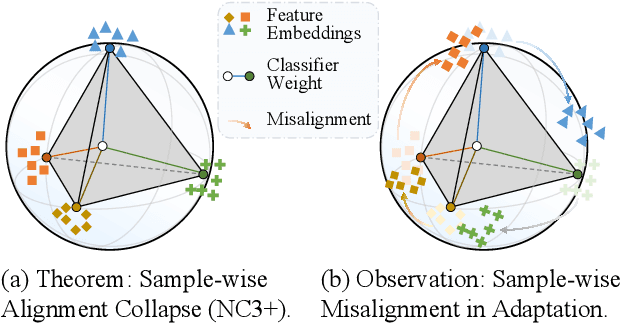
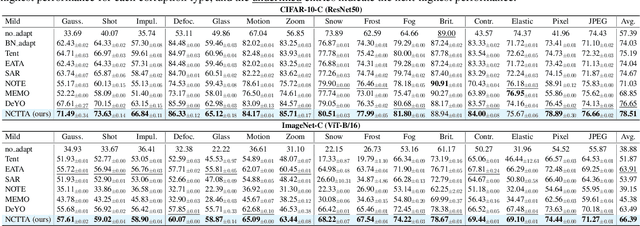
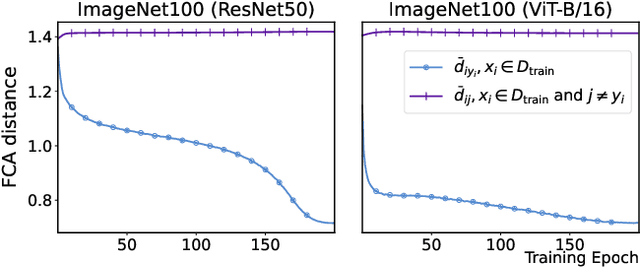
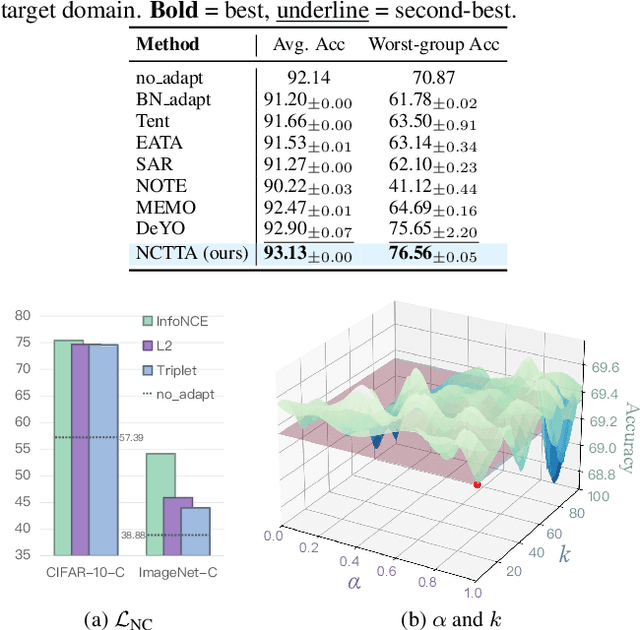
Test-Time Adaptation (TTA) enhances model robustness to out-of-distribution (OOD) data by updating the model online during inference, yet existing methods lack theoretical insights into the fundamental causes of performance degradation under domain shifts. Recently, Neural Collapse (NC) has been proposed as an emergent geometric property of deep neural networks (DNNs), providing valuable insights for TTA. In this work, we extend NC to the sample-wise level and discover a novel phenomenon termed Sample-wise Alignment Collapse (NC3+), demonstrating that a sample's feature embedding, obtained by a trained model, aligns closely with the corresponding classifier weight. Building on NC3+, we identify that the performance degradation stems from sample-wise misalignment in adaptation which exacerbates under larger distribution shifts. This indicates the necessity of realigning the feature embeddings with their corresponding classifier weights. However, the misalignment makes pseudo-labels unreliable under domain shifts. To address this challenge, we propose NCTTA, a novel feature-classifier alignment method with hybrid targets to mitigate the impact of unreliable pseudo-labels, which blends geometric proximity with predictive confidence. Extensive experiments demonstrate the effectiveness of NCTTA in enhancing robustness to domain shifts. For example, NCTTA outperforms Tent by 14.52% on ImageNet-C.